
The Internet of Things (IoT) has revolutionised the way industries operate, from smart homes and wearable health trackers to industrial monitoring systems and connected medical devices.
However, behind every successful IoT product lies a critical foundation: a reliable, intelligently designed printed circuit board.
PCB assembly for IoT devices is not the same as standard electronics manufacturing.
IoT hardware brings unique requirements — miniaturization, low power consumption, wireless connectivity, durability, and scalability — that demand thoughtful engineering and manufacturing expertise.
If you’re developing an IoT product for the US market, understanding these design and manufacturing considerations early can prevent costly delays, redesigns, and reliability issues.
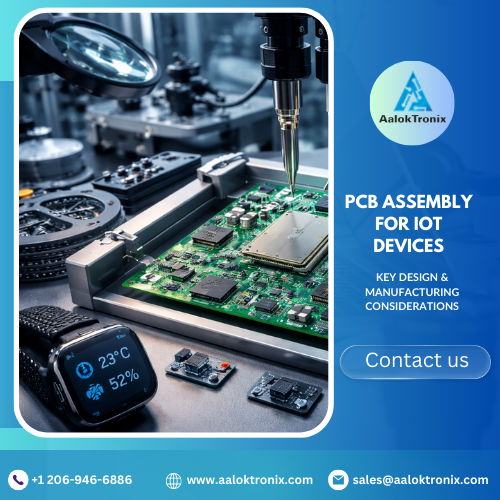
What Is PCB Assembly for IoT Devices?
PCB assembly for IoT devices refers to the fabrication and population of circuit boards specifically designed for connected, smart hardware.
Unlike traditional electronics, IoT PCBs must:
- Support wireless communication (WiFi, BLE, Zigbee, LTE, LoRa)
- Operate on low power (battery or energy harvesting)
- Fit within compact or wearable enclosures
- Perform reliably in diverse environments
- Maintain consistent production quality at scale
Because IoT devices are often deployed remotely — in factories, agricultural fields, hospitals, or homes — reliability is non-negotiable.
Why IoT PCBs Require Specialized Design Considerations
Many IoT product failures occur not because of software, but because of hardware decisions made early in the design phase.
- Miniaturization & High-Density Layouts
IoT devices are typically small — sometimes extremely small. This demands:
- Fine-pitch components
- BGA packages
- Multi-layer boards
- High-density interconnect (HDI) techniques
Improper layout spacing or poor stack-up planning can cause signal degradation, overheating, or assembly defects.
Key takeaway: Layout precision directly affects assembly yield and long-term reliability.
- Low Power Consumption Requirements
Most IoT devices rely on:
- Batteries
- Coin cells
- Solar
- Power-over-Ethernet (PoE)
- Energy harvesting systems
Low power PCB design is not optional — it defines product viability.
Key design strategies include:
- Optimizing trace widths for minimal loss
- Reducing leakage currents
- Strategic grounding planes
- Power domain segmentation
- Sleep-mode circuit design
A manufacturer experienced in IoT PCB assembly understands how these design choices affect both fabrication and functional testing.
- Wireless Connectivity & Signal Integrity
IoT devices live or die by connectivity.
PCB layout must account for:
- Controlled impedance traces
- RF shielding considerations
- Antenna placement
- Ground plane continuity
- EMI mitigation
Incorrect impedance routing can cause dropped connections, reduced range, or certification failures.
For US-market IoT devices, FCC compliance makes this especially critical.
- Environmental Durability for Industrial IoT
Not all IoT devices sit comfortably in a living room.
Industrial IoT environments may expose hardware to:
- Temperature extremes
- Moisture and humidity
- Vibration
- Dust or chemical exposure
PCB assembly strategies such as conformal coating, reinforced solder joints, and thermal management become essential.
How Does PCB Manufacturing Complexity Impact IoT Products?
IoT assembly often includes:
- Surface Mount Technology (SMT)
- Fine-pitch IC placement
- Double-sided assembly
- BGA / QFN components
- Microvias
- Controlled impedance layers
Each of these increases manufacturing complexity.
Choosing a PCB assembly partner experienced in high-density IoT hardware reduces risks such as:
- Tombstoning
- Solder bridging
- Cold joints
- Voiding under BGAs
- Inspection blind spots
Advanced inspection processes like AOI and X-ray become important for ensuring consistent production quality.
From Prototype to Mass Production: Scaling IoT PCB Assembly
Many IoT startups succeed technically but fail operationally due to scaling issues.
Prototype Phase Considerations
- Design for manufacturability (DFM) review
- Component sourcing strategy
- Quick-turn assembly
- Early functional validation
Production Phase Considerations
- Stable supply chain sourcing
- Cost optimization
- Yield improvement
- Process documentation
- Traceability systems
Transitioning from low-volume prototypes to thousands of units requires manufacturing planning from day one, along with PCB assembly pricing considerations.
How to Reduce Risk in IoT PCB Assembly
Successful IoT companies prioritize risk reduction.
Key steps include:
- DFM Early in Design
A thorough DFM review identifies:
- Spacing violations
- Thermal risks
- Manufacturability bottlenecks
- Component footprint mismatches
This alone can prevent costly redesign cycles.
- Choosing the Right PCB Material
FR4 may be sufficient for many IoT consumer devices. However:
- Industrial IoT may require high-Tg laminates
- RF-heavy devices may need low-loss materials
- Outdoor deployments may require enhanced moisture resistance
Material selection affects both cost and performance.
- Robust Testing & Inspection
IoT devices often operate unattended for years.
Recommended testing includes:
- Automated Optical Inspection (AOI)
- X-ray inspection for BGAs
- Functional testing
- Power consumption testing
- Environmental simulation when applicable
Skipping testing to reduce cost often leads to higher field failure rates.
Why US-Based PCB Assembly Matters for IoT Devices
For companies targeting the US market, domestic manufacturing provides advantages:
- Faster prototype iterations
- Easier communication with engineers
- Reduced supply chain delays
- Stronger IP protection
- Better compliance alignment
In rapidly evolving IoT markets, speed and reliability matter as much as cost.
Common Questions About PCB Assembly for IoT Devices
How much does IoT PCB assembly cost?
Costs depend on:
- Layer count
- Board size
- Component density
- Testing requirements
- Volume
Early DFM consultation improves cost predictability.
Can IoT PCBs be designed for extreme environments?
Yes, with correct material selection, protective coatings, and mechanical design strategies.
What testing is required for IoT devices?
Minimum:
- AOI
- Functional testing
Optional (depending on application): - Burn-in testing
- Environmental testing
- RF validation
Is overseas assembly cheaper for IoT?
Sometimes initially — but hidden costs such as delays, communication gaps, and quality variability often outweigh labor savings.
Key Design & Manufacturing Considerations Summary
When developing IoT devices, prioritize:
- Miniaturized yet serviceable layouts
- Low-power optimization
- Clean RF routing
- Environmental durability
- Scalable assembly processes
- Thorough DFM reviews
- Quality inspection protocols
Every decision you make early influences product reliability, certification success, and manufacturing efficiency.
Why Experience Matters in IoT PCB Assembly
IoT hardware brings unique engineering constraints. A manufacturing partner should understand:
- Fine-pitch assembly
- Wireless layout sensitivities
- Power optimization design impact
- High-density interconnect challenges
- FCC and compliance awareness
- Prototype-to-production scaling strategy
Experience reduces risk. Lack of it increases cost.
Final Thoughts
The success of an IoT product doesn’t depend solely on software or cloud integration — it begins with hardware reliability.
Thoughtful PCB design combined with experienced IoT-focused assembly ensures:
- Longer device lifespan
- Strong wireless performance
- Reduced warranty claims
- Faster time to market
- Higher customer trust
If you’re developing an IoT device and want to ensure your PCB assembly is built for performance, scalability, and reliability from day one, early collaboration with a US-based IoT PCB assembly company makes all the difference.
At Aaloktronix, we work with IoT innovators across the United States to provide high-quality PCB assembly services — from prototype validation to scalable production.
???? Planning your next IoT device?
Start with a technical review and quote consultation to ensure your design is optimized for reliable, production-ready assembly.