
The Internet of Things (IoT) has enabled billions of connected devices, from smart home sensors and wearable health monitors to industrial automation systems.
Most of these devices operate on limited power sources, such as batteries or energy-harvesting systems. That’s why low-power PCB design is one of the most important aspects of building reliable IoT hardware.
If a device consumes too much power, its battery drains quickly, leading to poor user experience, increased maintenance, and reduced product lifespan.
Designing energy-efficient PCBs ensures your IoT devices can operate longer, communicate reliably, and scale effectively in real-world deployments.
In this guide, we’ll explore how to design low-power PCBs for IoT applications, key engineering considerations, and practical techniques that help reduce power consumption without compromising performance.
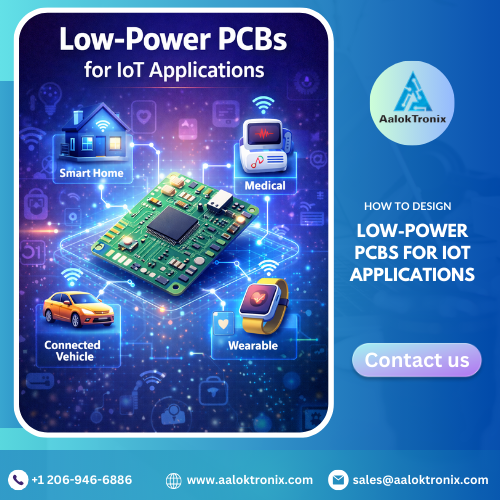
What Is Low-Power PCB Design for IoT?
Low-power PCB design focuses on minimizing energy consumption while maintaining device functionality. It involves selecting efficient components, optimizing circuit layout, and managing power distribution across the board.
Unlike traditional electronics, IoT devices often run for months or even years without battery replacement. This makes power optimization a top priority for engineers and hardware developers.
Low-power design strategies help achieve:
- Extended battery life
- Reduced heat generation
- Higher reliability
- Lower operational costs
- Improved sustainability
When implemented correctly, these design techniques allow IoT devices to operate efficiently even in remote or hard-to-access environments.
Why Power Efficiency Matters in IoT Devices
Power efficiency is critical because many IoT devices are deployed in locations where frequent maintenance isn’t practical. Examples include:
- Environmental sensors in agriculture
- Industrial monitoring equipment
- Smart building automation systems
- Wearable medical devices
If the hardware consumes excessive power, the device may require frequent battery replacement or recharging, which increases operational costs and reduces user satisfaction.
Efficient PCB design helps ensure that devices can remain operational for extended periods while maintaining stable wireless communication and data processing.
Key Components That Impact IoT Power Consumption
Several components directly influence how much power an IoT device consumes.
Microcontrollers (MCUs)
Modern IoT microcontrollers often include low-power sleep modes and energy-efficient processing capabilities. Choosing a microcontroller with optimized power states can dramatically reduce energy usage.
Wireless Modules
Communication technologies such as Wi-Fi, Bluetooth Low Energy (BLE), Zigbee, and LoRa each have different power requirements. Selecting the appropriate protocol for your application is essential.
Power Management ICs (PMICs)
Power management circuits regulate voltage and distribute power efficiently throughout the board. High-quality PMICs reduce power loss and improve system stability.
Sensors and Peripherals
Sensors, displays, and other peripherals can consume significant power if not properly managed. Using low-power sensor variants and enabling sleep modes helps conserve energy.
PCB Layout Techniques for Low-Power IoT Devices
Good PCB layout practices can significantly reduce power loss.
- Optimize Trace Routing
Shorter traces reduce resistance and minimize energy loss. Keeping power traces short and wide improves efficiency.
- Use Proper Ground Planes
A continuous ground plane improves signal integrity and reduces electromagnetic interference (EMI), which can indirectly affect power efficiency.
- Separate Analog and Digital Circuits
Separating sensitive analog circuits from noisy digital components reduces interference and improves overall system performance.
- Minimize Leakage Currents
Poor layout or excessive via usage can introduce leakage paths that drain power. Careful routing helps prevent this issue.
Power Management Strategies for IoT Devices
Sleep and Low-Power Modes
Many IoT systems operate intermittently. Implementing sleep modes allows devices to remain inactive until needed, conserving battery life.
Duty Cycling
Instead of running continuously, IoT devices can collect and transmit data at scheduled intervals. This technique dramatically reduces energy consumption.
Energy Harvesting
Some IoT devices use alternative power sources such as solar panels, vibration energy, or thermal gradients to extend operational life.
Efficient Voltage Regulation
Switching regulators are often more efficient than linear regulators, especially when powering high-current components.
Common Mistakes in Low-Power IoT PCB Design
Even experienced engineers sometimes overlook factors that increase power consumption.
Common mistakes include:
- Choosing high-power wireless modules unnecessarily
- Poor component placement causing inefficient power routing
- Ignoring firmware power optimization
- Failing to use sleep modes effectively
- Overlooking leakage currents in PCB design
Addressing these issues early in the design process can significantly improve device performance.
Testing Low-Power IoT PCBs
Once the board is designed and assembled, thorough testing is essential to verify power efficiency.
Common testing methods include:
- Power consumption analysis
- Battery life simulation
- Functional testing under real operating conditions
- Environmental testing for industrial deployments
These tests help ensure the device performs reliably before large-scale production.
Manufacturing Considerations for Low-Power IoT PCBs
Manufacturing quality also impacts power efficiency. Poor solder joints, incorrect component placement, or substandard materials can introduce electrical resistance and reduce performance.
Working with an experienced PCB assembly partner ensures:
- Accurate component placement
- Reliable soldering processes
- Consistent production quality
- Thorough inspection and testing
This is particularly important when transitioning from prototype to full production.
Final Thoughts
Low-power PCB design is essential for the success of modern IoT devices. By carefully selecting components, optimising layouts, and implementing smart power management strategies, engineers can build devices that operate efficiently for extended periods.
As IoT adoption continues to grow across various industries, hardware developers must prioritise energy-efficient design and reliable manufacturing processes to ensure the long-term performance of their devices.
At Aaloktronix, we support IoT innovators with reliable PCB assembly for IoT devices, helping transform design concepts into scalable, production-ready hardware.
Planning an IoT product? Connect with Aaloktronix to ensure your PCB design is optimized for power efficiency, reliability, and seamless manufacturing.