
The success of an IoT product depends on more than innovative features and wireless connectivity. Behind every reliable smart device is a well-designed and properly manufactured PCB that can withstand real-world operating conditions.
Unfortunately, many IoT products experience failures after deployment.
Whether it’s a smart agriculture sensor in a remote field, an industrial monitoring system on a factory floor, or a connected medical device, PCB-related issues can lead to downtime, increased maintenance costs, and customer dissatisfaction.
Understanding the most common IoT PCB reliability issues and how to prevent them can help manufacturers, engineers, and product developers improve product performance and longevity.
Let’s explore the reasons behind the common PCB failures in IoT devices and how to prevent them to increase the life of the device.
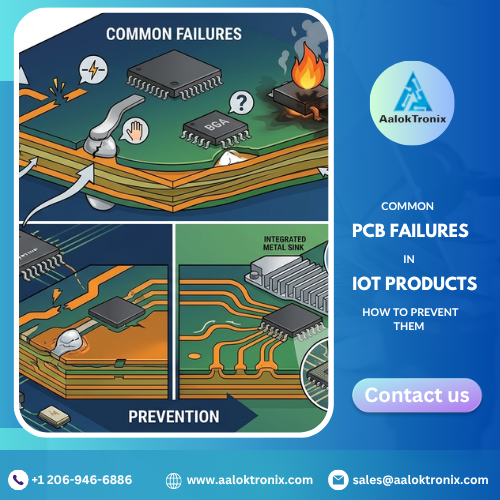
Why PCB Reliability Matters in IoT Devices
Unlike traditional electronics, IoT devices are often expected to operate continuously for years with minimal human intervention.
Many IoT applications are deployed in:
- Industrial facilities
- Agriculture fields
- Smart cities
- Healthcare environments
- Energy and utility networks
A single PCB failure can disrupt data collection, communication, automation, or safety systems.
This is why reliable PCB assembly for IoT devices should be considered from the earliest stages of product development.
What Are the Most Common PCB Failures in IoT Products?
Several recurring issues account for the majority of PCB failures in connected devices.
Let’s explore the most common problems and how to prevent them.
1. Thermal Damage and Overheating
Excessive heat remains one of the leading causes of PCB failure.
Common causes include:
- Poor component placement
- Inadequate ventilation
- High-current traces
- Power-hungry wireless modules
Overheating can result in:
- Component degradation
- Solder joint failures
- Reduced product lifespan
How to Prevent It
Implement proper PCB thermal management techniques.
Best practices include:
- Thermal vias
- Copper planes
- Heat sinks
- Strategic component placement
Proper thermal design is especially important in industrial IoT applications where devices may operate in elevated temperatures.
2. Poor Solder Joint Reliability
Weak or inconsistent solder joints are a major source of field failures.
This issue is often caused by:
- Incorrect reflow profiles
- Poor assembly processes
- Mechanical stress
- Temperature cycling
Symptoms include:
- Intermittent connectivity
- Unexpected device shutdowns
- Communication failures
How to Prevent It
Partnering with an experienced provider of IoT PCB assembly services helps ensure consistent solder quality and manufacturing control.
Advanced inspection methods, such as AOI and X-ray inspection in PCB assembly can identify hidden defects before products reach customers.
3. Moisture and Environmental Damage
Many IoT devices operate outdoors or in harsh industrial environments.
Exposure to:
- Humidity
- Rain
- Condensation
- Chemicals
- Dust
can lead to corrosion and PCB degradation.
How to Prevent It
Material selection plays a critical role.
Using the right materials outlined in Best PCB Materials for Industrial IoT Devices in Harsh Environments can significantly improve long-term reliability.
Additional protection methods include:
- Conformal coating
- Sealed enclosures
- Corrosion-resistant finishes
4. Signal Integrity Issues
Reliable communication is essential for IoT products.
Poor PCB design can introduce:
- Signal reflections
- Electromagnetic interference (EMI)
- Data transmission errors
This is especially problematic for devices using:
- Wi-Fi
- Bluetooth
- LoRa
- Cellular communication
How to Prevent It
Follow proven PCB layout optimization techniques.
Key considerations include:
- Controlled impedance routing
- Ground plane design
- RF isolation
- Proper antenna placement
5. Power Management Failures
Many IoT devices rely on batteries or energy-harvesting systems.
Poor power management can result in:
- Short battery life
- Unexpected resets
- Device instability
How to Prevent It
Implement strategies discussed in How to Design Low-Power PCBs for IoT Applications.
These include:
- Sleep modes
- Efficient power regulation
- Duty cycling
- Low-power components
Energy-efficient designs not only improve reliability but also reduce maintenance requirements.
6. Component Selection and Material Failures
Using components not rated for the intended operating environment can cause premature failures.
Common examples include:
- Consumer-grade components in industrial applications
- Low-temperature capacitors in outdoor deployments
- Inadequate PCB materials
How to Prevent It
Choose materials and components appropriate for:
- Operating temperature
- Humidity exposure
- Vibration levels
- Expected lifespan
Understanding PCB certifications like IPC, UL, and RoHS can also help ensure compliance and quality.
7. Manufacturing Defects
Even a well-designed PCB can fail if manufacturing quality is inconsistent.
Common manufacturing issues include:
- Misaligned components
- Insufficient solder
- Open circuits
- Short circuits
How to Prevent It
Perform:
- DFM reviews
- Automated inspection
- Functional testing
- Process validation
Following design for manufacturability (DFM) principles helps identify issues before production begins.
How Testing Improves IoT PCB Reliability
Testing is one of the most effective ways to reduce field failures.
Recommended testing methods include:
- Automated Optical Inspection (AOI)
- X-Ray Inspection
- Functional Testing
- Environmental Testing
- Burn-In Testing
These processes verify that every board performs as intended before it is deployed.
Why Reliability Should Be Considered During Design
Many reliability issues originate during the design phase rather than manufacturing.
By considering:
- Thermal performance
- Power consumption
- Environmental conditions
- Component selection
- Manufacturability
Early in the process, developers can significantly improve product quality and reduce long-term costs.
Final Thoughts
IoT devices are often deployed in environments where reliability is critical. A single PCB failure can lead to lost data, increased maintenance costs, and damaged customer trust.
By addressing common failure points, such as overheating, solder defects, moisture exposure, signal integrity issues, and power management challenges, organisations can significantly enhance product performance and longevity.
At Aaloktronix, we help innovators build reliable connected products through expert PCB assembly for IoT devices and rigorous manufacturing practices designed for real-world deployment.
Developing an IoT product? Connect with Aaloktronix to ensure your design is optimised for long-term reliability, scalability, and manufacturing success.