Bringing an IoT device to market involves much more than developing innovative features and reliable connectivity.
Before an IoT product can be sold or deployed, it must meet specific regulatory and compliance requirements that ensure safety, electromagnetic compatibility, environmental responsibility, and reliable performance.
Whether you’re building a smart home device, an industrial monitoring system, a connected medical product, or an agricultural sensor, understanding certification requirements early can save significant time, money, and redesign efforts.
This guide explains the most important certifications for IoT devices, including FCC, CE, IPC, and RoHS, and highlights how proper PCB design and manufacturing contribute to successful certification.
Why Are Certifications Important for IoT Devices?
IoT devices communicate wirelessly, collect data, and often operate in critical environments. Without proper compliance testing, products may:
- Fail regulatory approval
- Experience signal interference issues
- Create safety concerns
- Face costly redesigns
- Encounter delays in product launches
Certification requirements ensure products perform safely and reliably in real-world environments.
This is why selecting the right PCB assembly for IoT devices is a crucial step toward achieving successful compliance and market readiness.
What Is FCC Certification?
The Federal Communications Commission (FCC) regulates electronic devices that emit radio frequency signals in the United States.
Most IoT products require FCC compliance because they utilise technologies such as:
- Wi-Fi
- Bluetooth
- Zigbee
- Cellular
- LoRaWAN
Why FCC Compliance Matters?
FCC testing verifies that your device:
- Does not interfere with other electronic equipment
- Meets RF emission limits
- Operates safely within approved frequency ranges
Without FCC approval, IoT products generally cannot be legally marketed in the United States.
PCB Considerations for FCC Compliance
Good PCB design plays a major role in passing FCC testing.
Important factors include:
- Proper grounding
- RF shielding
- Antenna placement
- Signal routing
- Noise reduction
Following PCB layout optimisation techniques can significantly reduce electromagnetic interference issues.
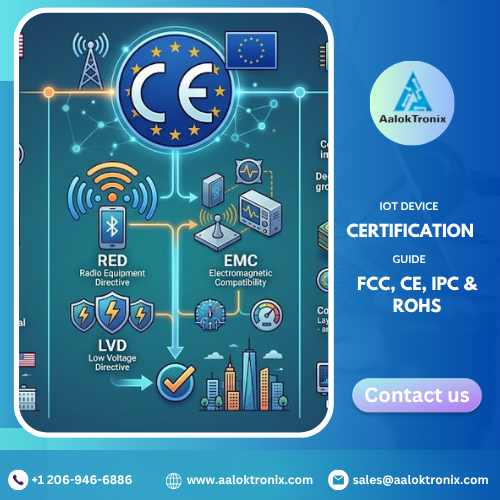
What Is CE Certification?
CE marking is required for many products sold within the European Economic Area (EEA).
Unlike the FCC, CE certification evaluates multiple aspects of a product, including:
- Electromagnetic compatibility (EMC)
- Safety
- Environmental compliance
- Wireless performance
Why CE Certification Matters?
CE certification demonstrates that a product meets European regulatory requirements and can legally enter European markets.
For companies planning global IoT deployments, CE compliance is often a necessity.
PCB Design Considerations for CE Compliance
Several PCB design decisions affect CE performance:
- Component placement
- Ground plane design
- Thermal management
- EMC mitigation
Implementing proper PCB thermal management techniques can help ensure stable operation during testing.
What Are IPC Standards?
IPC standards establish quality requirements for PCB manufacturing and assembly.
These standards help ensure consistency, reliability, and manufacturability.
Common IPC Standards
IPC-A-610
Defines acceptable electronic assembly workmanship.
IPC Class 2
Used for commercial and industrial products where reliable performance is required.
IPC Class 3
Used for mission-critical applications, including:
- Medical devices
- Aerospace systems
- Industrial controls
Following PCB certifications like IPC, UL, and RoHS helps manufacturers produce boards that meet industry expectations.
What Is RoHS Compliance?
RoHS (Restriction of Hazardous Substances) limits the use of hazardous materials in electronics manufacturing.
Restricted substances include:
- Lead
- Mercury
- Cadmium
- Certain flame retardants
Why RoHS Matters?
RoHS compliance:
- Improves environmental sustainability
- Supports global market access
- Demonstrates responsible manufacturing practices
Today, many customers and distributors expect RoHS-compliant electronics as a standard requirement.
How PCB Design Impacts Certification Success?
Certification isn’t something that happens after manufacturing. It starts during design.
Poor PCB design often leads to:
- Failed EMC testing
- Excessive RF emissions
- Thermal issues
- Reliability concerns
Key design considerations include:
Signal Integrity
Wireless communication depends on clean signal routing and impedance control.
Thermal Performance
Overheating can affect reliability and compliance testing results.
Implementing proper heat dissipation strategies improves performance.
Power Efficiency
Efficient designs generate less heat and interference.
Following best practices from How to Design Low-Power PCBs for IoT Applications helps improve certification outcomes.
Why Manufacturing Quality Matters for Compliance?
Even a well-designed PCB can fail certification if assembly quality is inconsistent.
Common manufacturing issues include:
- Solder defects
- Misaligned components
- Inadequate grounding
- Assembly contamination
Working with an experienced provider of IoT PCB assembly services helps reduce compliance risks and improve production consistency.
Advanced quality control methods, such as AOI and X-ray inspection in PCB assembly, help identify defects before testing begins.
Common Certification Challenges in IoT Products
Many IoT companies encounter similar issues:
RF Interference Problems
Caused by poor antenna placement or routing.
Excessive Power Consumption
Can create thermal and EMC issues.
Environmental Reliability Concerns
Particularly common in industrial deployments.
Using the right materials discussed in Best PCB Materials for Industrial IoT Devices in Harsh Environments helps improve long-term performance.
Product Reliability Issues
Failures often occur due to inadequate testing and validation.
Understanding common IoT PCB reliability issues can prevent costly field failures.
Certification Best Practices for IoT Developers
To improve certification success:
- Plan compliance requirements early
- Select compliant components
- Follow IPC design guidelines
- Use proper grounding and shielding
- Conduct pre-compliance testing
- Partner with experienced PCB manufacturers
Taking these steps early can significantly reduce project risk.
Final Thoughts
Certifications such as FCC, CE, IPC, and RoHS are essential for bringing reliable IoT products to market. They not only ensure regulatory compliance but also improve product quality, reliability, and customer confidence.
By combining smart design practices, rigorous testing, and high-quality manufacturing, companies can streamline certification processes and accelerate product launches.
At Aaloktronix, we support innovators with reliable PCB assembly for IoT devices, helping transform concepts into production-ready products that meet industry standards and compliance requirements.
Developing an IoT device? Contact Aaloktronix to ensure your PCB design, assembly, and manufacturing processes support successful certification and long-term reliability.