
IoT devices have become part of critical systems across manufacturing, agriculture, healthcare, energy, transportation, smart buildings, and consumer electronics. As these devices become more connected, the security of the underlying hardware is becoming just as important as software and cloud security.
A connected device can have strong encryption and secure software, but vulnerabilities at the hardware level can still create opportunities for unauthorized access, data exposure, device manipulation, or physical attacks.
This makes secure hardware design an important consideration from the earliest stages of an IoT product.
For PCB designers and product developers, security is not necessarily about adding one particular component or feature. It involves making deliberate decisions about components, PCB layout, power architecture, interfaces, debugging access, electromagnetic behaviour, manufacturing, and testing.
A well-designed PCB assembly for IoT devices should therefore consider security alongside reliability, power efficiency, manufacturability, and regulatory requirements.
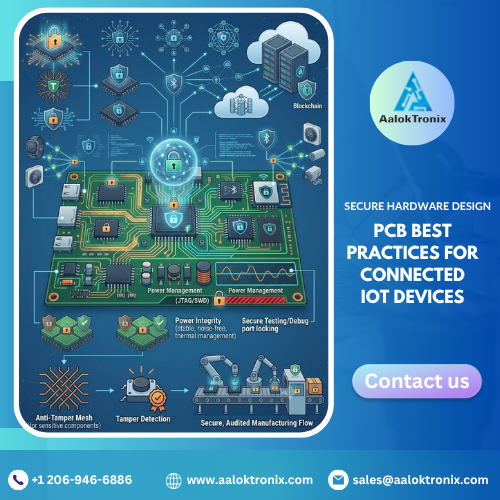
Why Hardware Security Matters for IoT Devices
IoT devices are often deployed outside traditional controlled IT environments.
A smart sensor may operate in a factory. An agricultural device may be installed in an open field. An industrial gateway may remain connected to a network for years.
This creates several potential security challenges.
IoT hardware may be exposed to:
- Physical access
- Unauthorized device modification
- Debug-interface access
- Electromagnetic interference
- Power manipulation
- Counterfeit or substituted components
- Supply-chain risks
- Unauthorized firmware access
A hardware vulnerability can potentially undermine security controls implemented elsewhere in the system.
That is why security should be considered during PCB and hardware architecture—not added only after the prototype is complete.
What Is Secure Hardware Design?
Secure hardware design means developing electronic hardware with security risks considered throughout the product lifecycle.
For IoT products, this can include:
- Secure microcontrollers
- Hardware-based cryptographic capabilities
- Secure boot support
- Protected memory
- Authentication mechanisms
- Tamper-aware design
- Controlled debug interfaces
- Secure communication interfaces
- Trusted component sourcing
- Manufacturing traceability
The PCB itself does not provide all of these security functions. Instead, PCB design and assembly provide the physical foundation that allows secure components and system-level protections to operate reliably.
1. Choose Security-Focused Components
One of the first decisions in secure IoT hardware design is selecting components that provide appropriate security capabilities.
Depending on the application, designers may consider:
- Secure microcontrollers
- Trusted execution environments
- Hardware security modules
- Secure elements
- Cryptographic accelerators
- Secure memory
- Authenticated communication controllers
A secure element, for example, can be used to protect cryptographic keys and support device authentication.
Component selection should be based on the actual threat model and product requirements rather than simply choosing the most feature-rich component.
2. Protect Cryptographic Keys
Cryptographic keys are fundamental to many IoT security systems.
If sensitive keys are stored insecurely, attackers may potentially extract them and impersonate legitimate devices.
Hardware designers should therefore consider:
- Where keys are stored
- How keys are generated
- Whether keys can be read externally
- Whether secure hardware storage is available
- How devices are provisioned during manufacturing
Using dedicated security hardware can help isolate sensitive credentials from general-purpose application processing.
This also makes secure manufacturing and device provisioning an important part of the overall security strategy.
3. Secure the PCB Debug Interfaces
Development interfaces such as JTAG, SWD, UART, and other debug connections are extremely useful during development.
However, unrestricted access to debugging interfaces on a deployed product can create security risks.
During development, engineers may need complete debugging access.
For production devices, however, the security architecture should determine whether interfaces should be:
- Disabled
- Permanently locked
- Password protected
- Cryptographically authenticated
- Physically inaccessible
The exact approach depends on the microcontroller, application, threat model, and security requirements.
A production PCB should not simply expose development interfaces without considering how they could be accessed.
4. Design a Secure PCB Layout
PCB layout affects more than electrical performance.
Good layout practices can also support hardware security by helping control electromagnetic behaviour, physical access, and critical signal exposure.
Important considerations include:
- Ground Plane Design
A properly designed ground structure can improve signal integrity and reduce unwanted electromagnetic coupling.
- Sensitive Signal Routing
Security-sensitive signals should be routed thoughtfully and separated from noisy or high-power sections where appropriate.
- Power Distribution
Stable power delivery helps prevent unintended resets and improves overall system reliability.
- Component Placement
Security-critical components should be positioned according to the overall physical and electrical security requirements of the product.
Following proven PCB layout optimization techniques can help reduce EMI, signal integrity, and manufacturability problems. Aaloktronix’s existing layout guide specifically discusses issues such as trace width, routing, and DFM considerations
5. Pay Attention to Power Integrity
Power instability can affect both reliability and security.
Unexpected voltage drops, resets, or unstable power rails can create unpredictable system behaviour.
For battery-powered IoT devices, power efficiency is particularly important.
Designers should consider:
- Voltage regulation
- Decoupling capacitors
- Power sequencing
- Brownout protection
- Battery monitoring
- Low-power operating modes
The principles discussed in How to Design Low-Power PCBs for IoT Applications can help engineers build more efficient and stable IoT hardware. The Aaloktronix guide covers power-management components, PCB layout, leakage currents, and testing of low-power IoT boards.
6. Reduce Unnecessary External Interfaces
Every external interface can potentially expand the attack surface of an IoT product.
Depending on the application, designers should evaluate whether the product really needs:
- USB
- UART
- Ethernet
- SPI
- I²C
- GPIO access
- External memory
- Removable storage
The objective isn’t necessarily to eliminate interfaces. Instead, each interface should have an appropriate security and access-control strategy.
For example, a service interface intended only for factory testing should not automatically remain fully accessible after deployment.
7. Consider Secure Boot and Firmware Authentication
Hardware and firmware security are closely connected.
Secure boot mechanisms can help ensure that a device executes authorized firmware rather than unauthorized or modified code.
A secure architecture may use:
- Hardware root of trust
- Cryptographic verification
- Secure boot
- Signed firmware
- Protected key storage
- Controlled firmware updates
The PCB must reliably support the components and memory architecture required for these mechanisms.
This is another reason why secure hardware planning should happen before PCB production rather than being treated as a software-only concern.
8. Design for Secure Firmware Updates
IoT devices often need firmware updates after deployment.
Updates may fix:
- Security vulnerabilities
- Software bugs
- Performance problems
- Compatibility issues
However, an update mechanism itself must be protected.
A secure update architecture should consider:
- Firmware authentication
- Digital signatures
- Version control
- Rollback protection
- Secure key management
- Recovery mechanisms
From a hardware perspective, the PCB must provide reliable support for the processor, memory, communication interfaces, and security components required by the update architecture.
9. Protect Against Counterfeit Components
Component authenticity is another important consideration for secure IoT hardware.
Counterfeit or unauthorized components may introduce:
- Reliability problems
- Unexpected electrical behavior
- Unknown functionality
- Supply-chain security concerns
This is particularly important for products manufactured at scale.
Working with an established electronics manufacturing partner and maintaining appropriate component traceability can help reduce supply-chain risks.
Aaloktronix’s broader manufacturing capabilities include PCB assembly, prototyping, turnkey manufacturing, low-to-medium production, and other electronics manufacturing services.
10. Use DFM Without Compromising Security
Security requirements should not be added in a way that makes the PCB unnecessarily difficult to manufacture.
A secure design should still consider:
- Component availability
- Placement accuracy
- Solderability
- Assembly tolerances
- Test access
- Inspection requirements
- Production scalability
Following design for manufacturability (DFM) principles can help engineers identify manufacturing issues before they become expensive production problems.
The goal is to create a design that is both secure and practical to manufacture.
11. Consider PCB Inspection and Testing
Security features are only useful if the underlying hardware is assembled correctly.
Manufacturing defects can affect:
- Secure elements
- Cryptographic components
- Memory devices
- Power circuits
- Communication interfaces
- Processor connections
Inspection methods such as AOI and X-ray can help identify assembly defects.
For example, AOI and X-ray inspection in PCB assembly can be used according to board complexity and component requirements.
Aaloktronix’s inspection guide explains that AOI is useful for visible defects, while X-ray inspection can identify hidden problems such as defects beneath BGAs and other components.
12. Build Security Into the Prototype Stage
Security shouldn’t wait until mass production.
During prototype development, engineers should evaluate:
- Debug access
- Secure boot
- Key storage
- Component authenticity
- External interfaces
- Firmware update mechanisms
- Physical access
- Communication security
Early testing makes it easier to change component selections and PCB architecture.
This is especially important before transitioning from prototype to production.
The Aaloktronix guide Prototype to Mass Production discusses the importance of DFM, component availability, testing, compliance, pilot production, and scalable manufacturing when moving an IoT product toward volume production.
How Secure Hardware Design Connects With IoT PCB Assembly
Secure hardware design ultimately needs to translate into a reliable production PCB.
This requires coordination between:
- Hardware engineers
- PCB designers
- Firmware developers
- Security teams
- Component suppliers
- PCB assembly manufacturers
- Testing teams
An experienced IoT PCB assembly partner can help ensure that production processes accurately reproduce the approved design.
This is particularly important when the board contains:
- Fine-pitch security components
- RF modules
- BGAs
- Secure elements
- High-density routing
- Multiple communication interfaces
The goal is to maintain consistency between the validated prototype and production units.
Security, Reliability, and Compliance Work Together
Hardware security should not be treated as an isolated engineering requirement.
A robust IoT product needs to balance security with:
- Reliability
- Power consumption
- Thermal performance
- Regulatory compliance
- Manufacturability
- Cost
- Product lifespan
For example, certification requirements may influence PCB layout, grounding, shielding, and component selection.
The IoT Device Certification Guide explains how PCB design and manufacturing considerations can affect regulatory compliance.
Aaloktronix’s certification content also covers IPC, UL, and RoHS considerations and explains how certification requirements can influence materials, testing, documentation, and traceability.
Common Secure PCB Design Mistakes to Avoid
Some security-related hardware mistakes can be prevented during the design review stage.
Avoid:
Leaving Production Debug Ports Unprotected
Development interfaces should have a deliberate production security strategy.
Storing Sensitive Credentials Insecurely
Critical keys should use appropriate secure storage mechanisms.
Ignoring Component Authenticity
Use trusted sourcing and appropriate traceability.
Treating Security as a Software-Only Problem
Hardware architecture influences the security capabilities available to firmware.
Adding Security Features Too Late
Late-stage security changes can require PCB redesigns and certification retesting.
Ignoring Manufacturing Quality
A secure architecture still depends on correctly assembled hardware.
Secure Hardware Design Checklist for IoT Products
Before moving an IoT PCB into production, review:
- Secure processor or microcontroller selected
- Cryptographic key storage considered
- Secure boot architecture defined
- Firmware authentication planned
- Debug interfaces secured
- External interfaces reviewed
- Power architecture validated
- PCB layout reviewed for EMI and signal integrity
- Component sourcing and traceability addressed
- DFM review completed
- AOI/X-ray requirements defined
- Functional testing defined
- FCC/CE requirements evaluated where applicable
- Production security requirements documented
This checklist can help engineering teams identify hardware-security considerations before the design reaches volume production.
Final Thoughts
IoT cybersecurity starts before a device connects to the internet.
The PCB, components, power architecture, debug interfaces, secure elements, and manufacturing process all contribute to the security foundation of a connected product.
By incorporating security considerations early, engineers can reduce redesign risks while building IoT hardware that is more reliable, maintainable, and prepared for real-world deployment.
At Aaloktronix, we support IoT innovators with PCB assembly for IoT devices, from prototype validation through scalable production. Our capabilities cover PCB assembly, prototyping, turnkey manufacturing, and production support for connected electronics.
Developing a connected IoT product? Work with your engineering and manufacturing teams early to evaluate PCB design, component selection, assembly, inspection, and production requirements together.